
Lean In or Lawyer Up
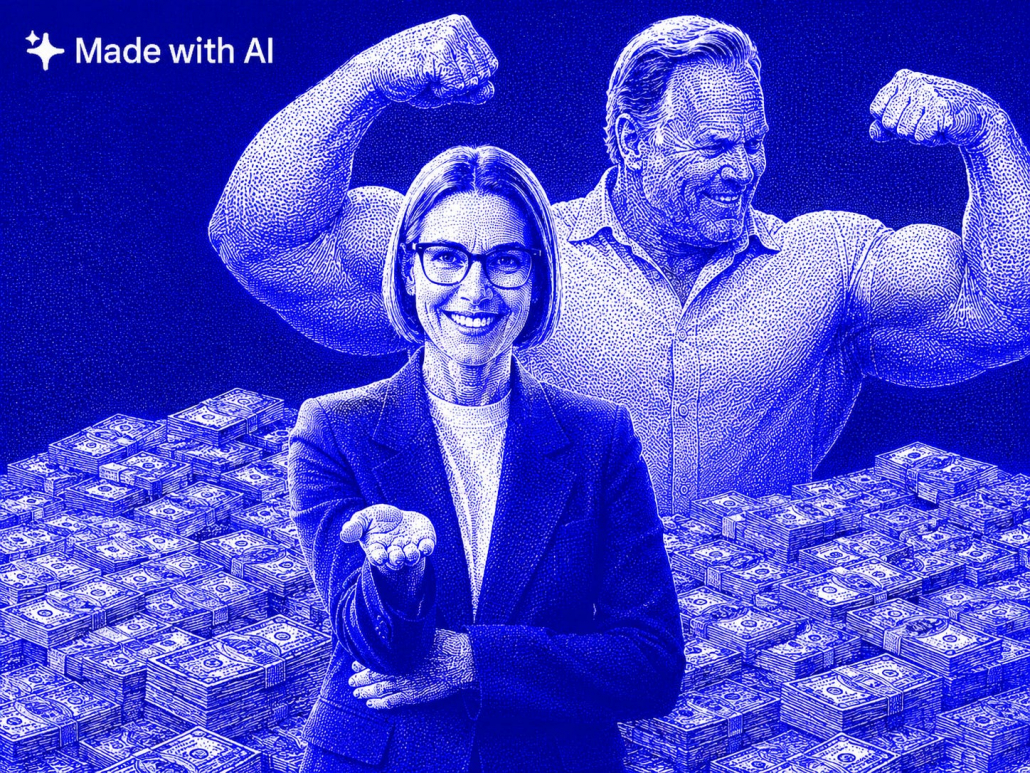
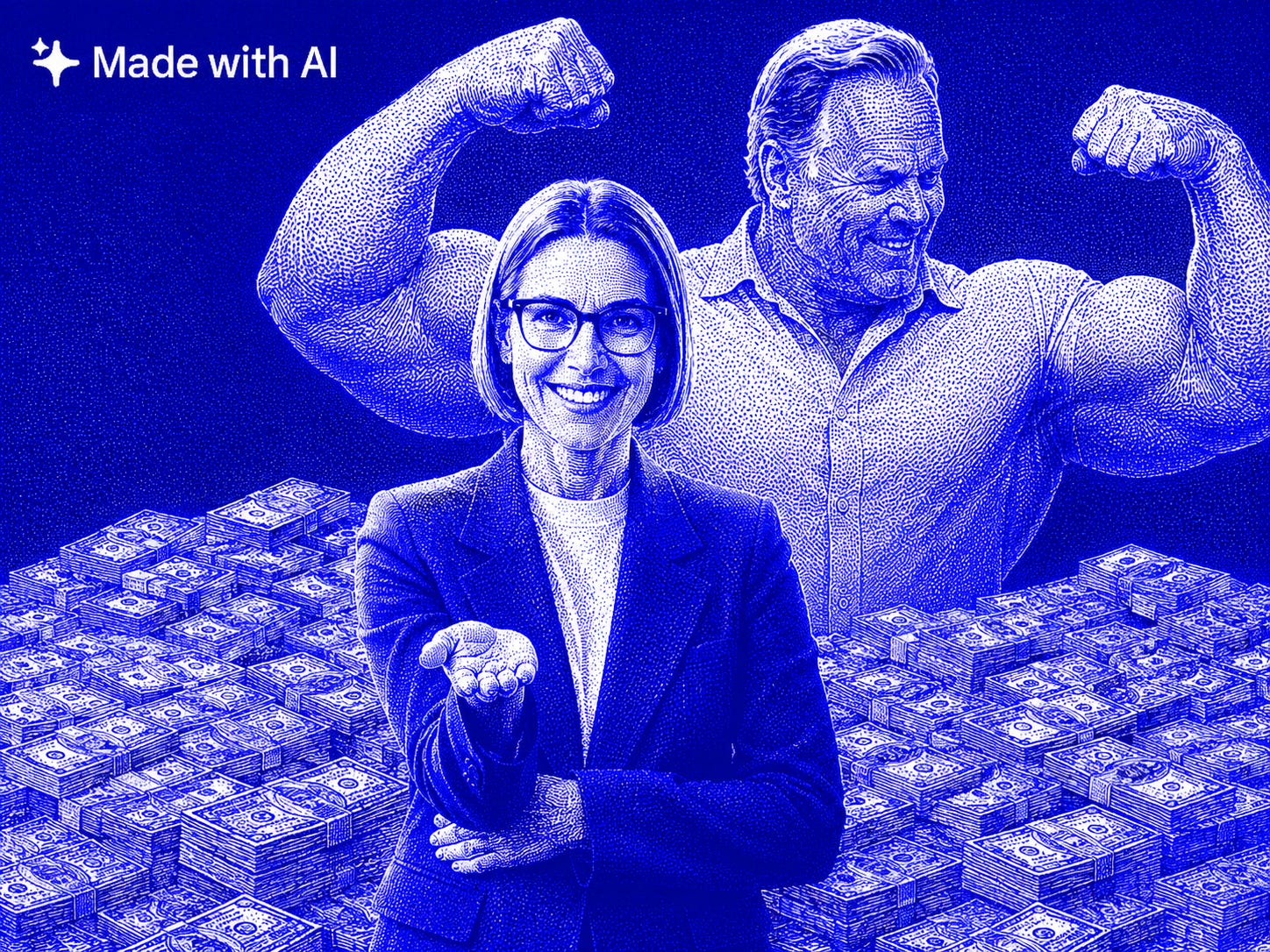
A U.S. Senate candidate got caught looking suspiciously swole in a birthday photo. Turns out, his consultant edited it with AI. Instead of issuing a denial, his team leaned in and posted their own AI parody video.
A thousand miles away, another Senate campaign got hit with an AI-assisted attack ad featuring the candidate. That team did the opposite and called the ad illegal, putting the state’s deepfake law at the center of the story.
Campaigns seem to be taking two different paths: embrace the fake or invoke the law against it. Both are turning out to be good strategies capture a news cycle.
The Signals This Week
1. A Cartoon Bicep Took Over the Michigan Senate Race
An AI image of Mike Rogers went viral, and his campaign learned the new rule of the road in about an hour.
A staffer at a campaign vendor posted an AI-altered image of GOP Senate candidate Mike Rogers with cartoon-superhero arms, built off a real 2024 photo and stamped with X’s automatic “Made with AI” label. It drew more than a million views and open mockery from Mallory McMorrow and Justin Amash. The Rogers campaign said its own staffers did not make the image, then leaned into the moment anyway with an AI-generated video of swole Rogers as a hero, saving cats from trees and lifting cars with his bare hands with the caption “Haters will say it’s AI.”
The Signal: The campaign that reclaims the controversy with its own content clearly won the exchange. Careful denial earns little attention by comparison.
Source: AOL / Detroit Free Press, Detroit News
2. In Minnesota, the Deepfake Became the Attack
A super PAC ran an AI image of Peggy Flanagan. She turned the state’s untested deepfake ban into the story.
In Minnesota’s DFL Senate primary, the North Star Dawn super PAC, aligned with rival Angie Craig, began airing a TV attack ad that Lt. Gov. Peggy Flanagan’s team says uses an AI deepfake of her, a manipulated image showing her with piles of corporate money. Flanagan’s camp called it possibly illegal under Minnesota’s law barring deepfakes in political ads and said it is weighing legal options. The PAC called the claim baseless and said it follows every state and federal law. Whether the statute even applies is itself unsettled, which is why reporters are framing this as a potential first test of the law.
Flanagan made her opponent’s use of AI the story and put an untested statute on the table before anyone had ruled on whether it applied.
The Signal: In a state with a deepfake-in-ads law, an opponent’s deepfake is an effective gift of free media for the cycle, even when the law itself is untested.
3. The Influencer Payment, Not the Deepfake, Drew the Complaint
California’s primary is the first real disclosure stress test, and the enforcement action landed somewhere surprising.
AI attack videos are flooding California’s primary races, with consultants framing AI as a game-theory problem where opting out reads as unilateral disarmament. The concrete enforcement action sat elsewhere, in the Democratic primary for governor. Two content creators backing Xavier Becerra filed a complaint with the Fair Political Practices Commission against Tom Steyer’s campaign over alleged undisclosed paid-influencer posts. Steyer reportedly paid at least eight influencers more than $123,000, with a single placement as high as $100,000, against California’s SB 678 paid-content disclosure rule.
The Signal: If your shop runs influencer or creator programs into a 2026 race, the compliance exposure is the disclosure label on paid posts.
Source: CalMatters, SF Standard
4. Eight Cents a Second
xAI’s new video model put a talking, lip-synced spokesperson within reach of a petty-cash budget.
xAI launched Grok Imagine Video 1.5 and it took the top spot on the Image-to-Video Arena, a 52-point Elo jump over the prior version, ahead of ByteDance’s Seedance and Google’s Veo. It generates video at 24 frames a second with built-in synchronized audio, in clips up to fifteen seconds, priced from $0.08 per second for 480p and $0.14 at 720p through the API.
While the actual model quality is somewhat subjective, the number that matters is eight cents a second with native audio. A believable talking-head clip now costs less than a stock photo and skips the voice-over step entirely.
The Signal: In the midterms, someone will face an opponent who can generate a hundred audio-synced variants for the price of one focus group. The cost collapse is why this single week also produced two live-race AI incidents and three disclosure regimes.
Source: xAI, The Decoder
5. AI Music Just Got a $5.4 Billion Stamp of Legitimacy
Suno doubled its valuation in seven months and teased a model the labels helped build.
AI music generator Suno raised a $400 million Series D led by Bond Capital at a $5.4 billion valuation, more than doubling its $2.45 billion mark from November. The company said it will roll out its first music model “developed in partnership with the music industry” in the coming months. Warner Music settled and licensed with Suno last November. Universal, Sony, and Germany’s GEMA are still suing, and recently moved to add more than 61,000 songs to their training-data complaint.
The Signal: Once a rights-cleared model ships, AI music stops being a legal-gray novelty and becomes a normal line in a content budget. Ad scoring, campaign anthems, persona audio, cheap and clearable.
Source: TechCrunch, Music Ally
6. New York’s Synthetic-Performer Rule Takes Effect June 9
The first state disclosure law for AI humans in ads bites commercial work, not campaigns.
New York’s first-in-the-nation synthetic-performer law takes effect June 9. It requires a conspicuous disclosure in any advertisement that includes a digitally created, human-seeming asset made with generative AI, when the advertiser knows it is there. Penalties run $1,000 for a first violation and $5,000 after. The law is scoped to advertising for a commercial purpose and exempts expressive works like film, TV, and games, audio-only ads, and AI used solely for translation.
The Signal: Anyone running AI-generated spokespeople or models in commercial creative into New York needs the disclosure stamp in place by June 9. This is a likely template other states will copy next.
Source: Cooley, National Law Review, Reed Smith
7. Anthropic Says AI Now Writes 80% of Its Own Code
The frontier lab that is also one of Washington’s fastest-growing lobbying forces just argued, on the record, for a regulatory off-switch.
Anthropic published “When AI Builds Itself”, arguing that the work of building AI is increasingly being done by AI. As of May 2026, the company says more than 80% of the code merged into its own codebase was written by Claude, up from low single digits before Claude Code launched in early 2025, and its engineers now merge about eight times as much code per day as in 2024. The piece is careful to say full recursive self-improvement has not happened, “we are not there yet,” but argues the option to slow or pause frontier development should stay open, and says Anthropic would pause if rival labs verifiably did the same.
The Signal: “AI now writes 80% of the code at the company that builds it” is the stat your clients, your opponents, and the members you brief will all be quoting by fall. Know where it comes from and what it leaves out before someone uses it on you. And watch the move underneath it: the leading safety-branded lab is now lobbying for its own brake, which reshapes the AI-policy fight your public-affairs work is walking into.
Source: Anthropic; coverage via Tom’s Hardware, Scientific American
Thanks for reading. If this landed with you, forward it to one person who should be reading it.
Best,
Ben


Leave a Reply
Want to join the discussion?Feel free to contribute!