

How Many Wheels on a Big Rig?
Welcome back to The Influence Model, your weekly roundup of how AI is reshaping influence and opinion shaping in Washington.

Coca-Cola just released their AI-generated holiday campaign. Again. After last year’s backlash, they doubled down. The “Holidays Are Coming” trucks are back, only this time every truck has a different number of wheels because consistency is apparently optional when you can produce in a month what used to take a year.
The efficiency gains are real. So too might be the trust tax. Below, we track seven signals showing how AI is collapsing production timelines while creating new competitive dynamics for Washington and beyond.
1. Coca-Cola Cuts Holiday Campaign Production from 12 Months to 30 Days Using AI
Chief Marketing Officer says what used to require a year now takes around a month
Coca-Cola deployed AI to create the second installment of their iconic “Holidays Are Coming” commercial. Studio Secret Level and five AI specialists generated the campaign from more than 70,000 video clips. Chief Marketing Officer Manolo Arroyo told the Wall Street Journal the project was “cheaper and speedier” than traditional production. What used to require a year now takes around a month.
The Verge noted serious quality issues. Every truck has a different number of wheels. The style can be inconsistent and the author suggests Coca-Cola didn’t use the most realistic models available.
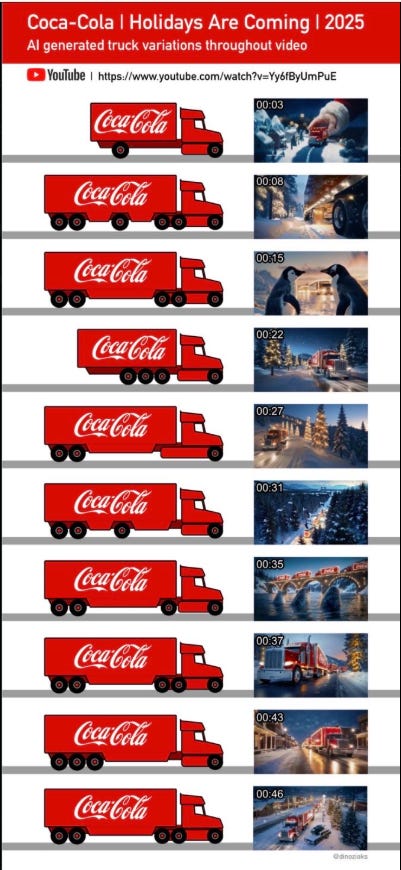
This happened before. Last year’s AI holiday campaign drew criticism. Coca-Cola ran it anyway. Now they’re doing it again.
Something to think about: The tells matter, but maybe not as much as the speed and effectiveness. If you’re saving 11 months on production cycles, a few people noticing inconsistent truck wheels might be an acceptable trade (Important to note: the X post with the above photo got 4M views). The question is whether your audience cares enough about authenticity to offset the speed advantage. In Washington, where response windows compress constantly, that speed differential could mean controlling the narrative before opponents finish their approval chains. But sloppy execution also creates ammunition for critics. Will velocity gains exceed the trust you’ll lose from visible AI artifacts?
Read more:
-
The Verge: Coca-Cola’s new AI holiday ad is a sloppy eyesore
-
People: Coca Cola Doubles Down on AI Commercial Following Last Year’s Backlash
2. First AI-Native Communications Agency Launches with GEO Focus
New firm bets entire business model on generative engine optimization and “citation economy”
Andy Pray and Daria Dubois launched Wild Signal, billing it as “the world’s first AI-native communications agency.” The firm targets the “citation economy” where AI search engines determine brand visibility. The Initial focus is on travel, technology, transportation, and hospitality.
The structure is notable with a distributed team and outcomes-based billing instead of hourly rates. The debut platform is Wayfinder, which maps brand visibility across large language models using generative engine optimization. Earned OS, a “fully executional operating system built for the AI era,” launches this spring.
Wild Signal’s bet is that GEO matters enough to build an entire agency around it. Or, that’s it’s better to be a GEO ‘agency’ instead of software platform. You decide.
Something to think about: The proliferation of GEO-focused offerings signals where operators think the next battleground lives. But GEO will evolve like SEO did—a constant cat-and-mouse game between optimization tactics and model updates. Anyone claiming they’ve solved GEO permanently is selling snake oil in an uncertain market.
Read more:
3. PR Firms Report Profit Pressure as AI Reshapes Industry Economics
Midsize firms report most pain as 62% increase AI spending while profits decline
Only 44% of PR firms expect profit gains as AI forces industry restructuring, according to new data from Axios. Midsize firms with 30 to 100 employees report the most pain—42% expect revenue and profit declines, compared with 31% of small firms and 19% of large operations.
Meanwhile, 62% of firm leaders report spending on AI-powered technology. Most PR professionals use AI for written content, note-taking, ideation, and social listening.
The pressure on pricing and capacity to deliver is clear. Clients realize AI can handle tasks they previously paid agencies to execute and so firms face pressure to demonstrate new value beyond execution.
Parry Headrick, LinkedInfluencer and owner of Crackle PR, pushed back: “Firms like mine are crushing it now in large part because of rather than in spite of the rise of AI.” Some operators have found the new value proposition while others haven’t.
Something to think about: In the mid-to-long-run, the firms that will thrive will sell judgment, relationships, and proprietary insight. For internal teams, this creates opportunity. You can bring previously outsourced work in-house using AI tools, then redirect budget toward strategic counsel you actually need. The executional moat is eroding. Relationship and judgment moats remain.
Read more:
4. AI Collapses Writing as Signal of Skill
Analysis of 2.7 million job applications shows top workers hired 19% less after ChatGPT launch
Research from Princeton and Dartmouth analyzed 2.7 million job applications before and after ChatGPT’s release. Before large language models, customized proposals on platforms like Freelancer.com required substantial time and effort. Employers paid premiums for quality writing because it signaled competence.
After LLMs, anyone can generate polished proposals in seconds. The signal collapsed. Top workers now get hired 19% less often. Bottom-tier workers get hired 14% more. The job market became less meritocratic because writing stopped distinguishing skill levels.
The pattern extends beyond freelancing. Any credentialing system built on written assessment faces the same dynamic.
Something to think about: With writing no longer a signal, oral interviews, work simulations, and portfolio-based evaluation become more valuable. But this also means your own communications face the same scrutiny. When everyone can produce polished text, differentiation comes from ideas and relationships, not presentation. The executional bar has risen while the strategic bar matters more.
Read more:
5. ChatGPT Restructures Brand Visibility Infrastructure
October 18 update compressed brand mentions per response from 6 to 3.5 as platform builds commerce layer
AI search whisperer Joshua Blyskal documented what he calls the “Entity Update” in ChatGPT’s recommendation engine. On October 18, the system began tagging brands as structured entities, fundamentally changing how it surfaces companies in responses.
The average number of brands mentioned per response dropped from six to 3.5. Average brand visibility fell 31%. The competitive gap between the first and tenth-ranked brands compressed by 23%.
Blyskal argues this represents infrastructure building for ChatGPT Shopping. The system needs to confirm these are real businesses with transaction capability, not just recommendations. It’s building the data layer to handle commerce, not just information retrieval.
Something to think about: Every platform update shifts the rules of the game. For policy shops, the lesson applies beyond commerce. As models evolve their entity recognition and citation patterns, the organizations and issues they surface will shift. Track how your policy priorities appear in model outputs over time. When visibility drops, investigate whether the change reflects market dynamics or structural platform updates. If it’s structural, you can potentially influence it through strategic earned media placement. If it’s algorithmic, you might need different tactics.
Read more:
6. AI-Generated Country Song Tops Billboard Chart
Breaking Rust’s “Walk My Walk” accumulates 2.2 million Spotify listeners
An artist called Breaking Rust is charting on Billboard with a song titled “Walk My Walk.” The music is entirely AI-generated. The actual creator is “Abier Rivaldo Taylor.”
I’ve listened to it and it’s pretty good. Breaking Rust has accumulated over 30,000 Instagram followers and 2.2 million Spotify listeners. The song follows predictable country music patterns—specific accent, familiar cultural references, standard chord progressions. AI can replicate genre conventions when humans review the output.
Aaron Ryan from Whiskey Riff argues this “should infuriate us all,” noting streaming platforms and charts now reward whoever can produce content fastest, not necessarily best.
Something to think about: Entertainment value matters more than authenticity for many audiences. Country music has recognizable patterns. AI can execute those patterns at scale. The same logic applies to political messaging, which also follows well-defined patterns. Your adversaries are already doing this. The campaign timelines you’re used to—the ones measured in weeks or months—compress to days when someone’s generating variants at volume. The defensive play is speed. The offensive play is figuring out which message patterns in your policy space are replicable at scale, then testing variants faster than opponents can respond. Quality still matters, but velocity increasingly determines who controls the narrative window.
Read more:
7. Bill Ackman Posts 30-Minute AI-Generated Elon Musk Video, Gets 3.3 Million Views
Hedge fund manager and activist praises synthetic Musk as “brilliant spokesperson” before revealing video and words are entirely AI
After Zohran Mamdani’s New York City mayoral election victory, activist hedge fund manager Bill Ackman posted a 30-minute video of Elon Musk explaining “what’s going on in America right now, and what are the risks for our country in the world.”
Ackman lauded Musk as “a brilliant spokesperson and incredibly articulate.” Then he paused. “I’m pretty sure that this video is AI. Not only the video, but also the words.”
He noted it’s nearly impossible to tell the difference. Yet Elon remains “a very, very effective spokesperson.”
Ackman’s tweet has 3.3 million views. The 31-minute YouTube video has 395,000 views.
Something to think about: A billionaire investor amplified a fully synthetic spokesperson to his 3.3 million followers. The disclosure came after the praise. This is an early look of mainstream adoption of AI-generated surrogates treated as legitimate political commentary. For Washington operators, synthetic spokespeople can now achieve reach and credibility that rival authentic voices, particularly when amplified by influential accounts. Many are already testing whether audiences care about the difference.
Read more:
Speed is starting to matter more than polish. While most approval chains still assume quality requires time, opponents are running twenty message variants in the time it takes to finalize one statement.
Some teams in Washington are adjusting their workflows. Most are already behind.
Thanks for reading this edition of The Influence Model. Hit reply and let me know what resonates with you.
Best,
Ben


Leave a Reply
Want to join the discussion?Feel free to contribute!