 Shaper Collective
ChatGPT Gets Ads. Washington Gets a New Channel.
How ChatGPT Ads Could Make Grassroots Campaigns Conversational + Signals This Week

This week, OpenAI’s ‘last resort’ became the subject of its newest press release. If you haven’t heard yet, OpenAI announced advertising in the free and lowest paid ChatGPT tier.
To nobody’s surprise, OpenAI has sought to monetize its roughly 800 million users. Two years ago, ads may have felt annoying, but justified. At the time, there was only one “genius in a datacenter” on this earth.
But that world is gone. And with it, the assumption that AI chat would remain an ad-free zone. This matters for campaigns in Washington. Conversations with AI chatbots are unusually effective at changing minds. OpenAI just created a new persuasion surface that will not be ignored.
OpenAI’s hegemony is less certain than ever. Anthropic is scoring national coverage for its helpful agents in publications like the Wall Street Journal and Google continues to harness its broad ecosystem to ship features like Gemini that can search your drive.
The choice to pursue ads is a positioning statement. OpenAI is going consumer-first, monetizing user attention like Facebook. Anthropic commands higher dollars through quality and trust. Google sits somewhere between with an ecosystem that can delay ad monetization.
Whether other AIs adopt ads or not, chat-recommended advertising is likely to become a multi-billion-dollar industry.
What Do ChatGPT Ads Look Like?
OpenAI has separated the advertising experience from the chat response itself. Ads appear below ChatGPT’s answer as a clearly labeled “Sponsored” card.
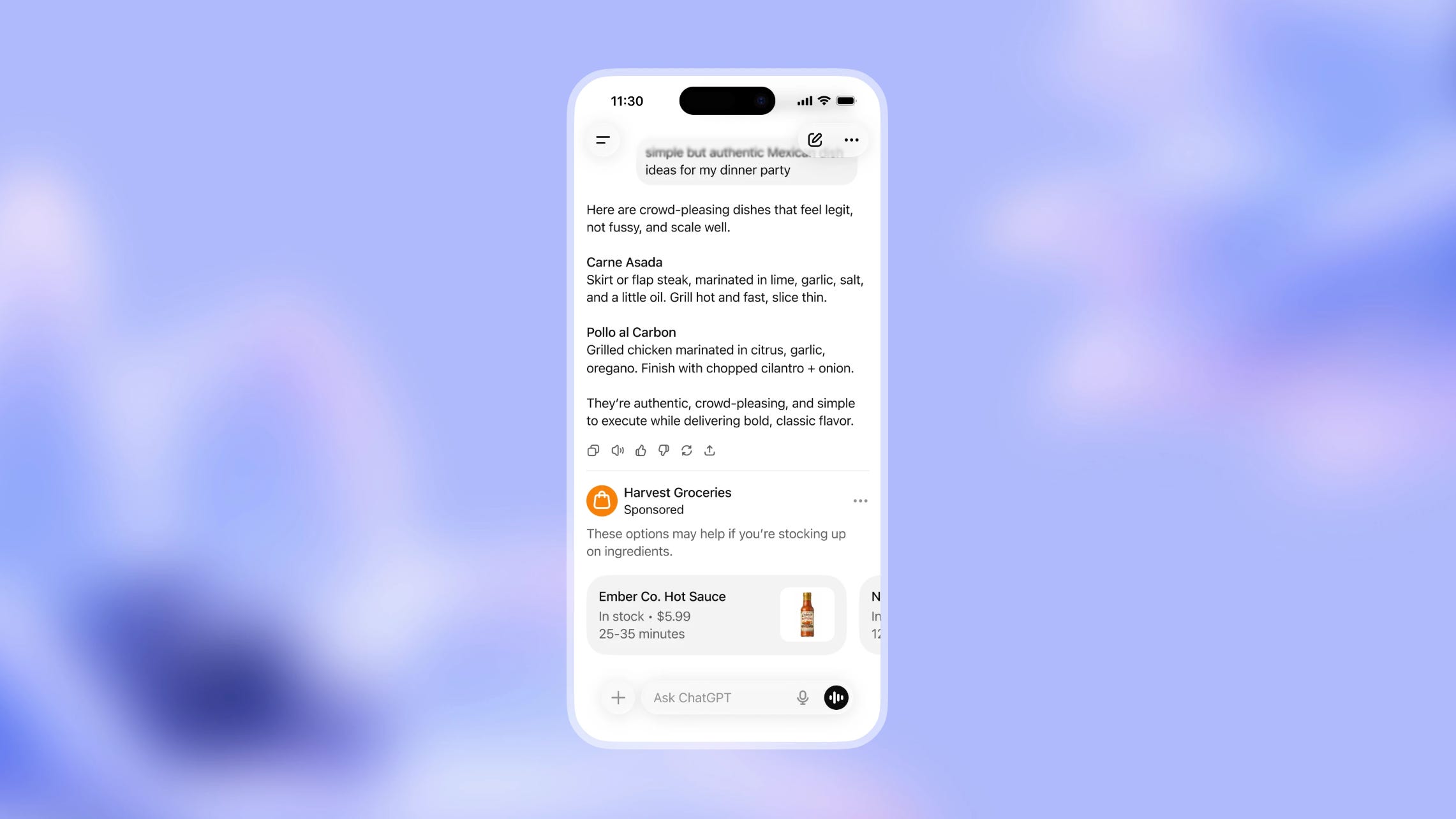
They have also shared a version where the ad becomes conversational—helping a user think through a purchasing decision in a dialogue. We’ll get into how this could be very interesting for grassroots campaigns below.
How Do Ads Target Users?
That separation between chat and ads is deliberate. OpenAI has calculated, correctly, that trust is its most valuable asset. People don’t want their ‘helpful’ chatbot to secretly be a salesperson. According to the company, “responses in ChatGPT will not be influenced by ads.” Targeting is based on inferred intent, not necessarily full chat history.
Take that claim seriously, but not literally. OpenAI’s business model now depends on keeping users engaged long enough to see ads. The chat response may not be “influenced” in a direct, transactional sense. But the platform’s incentives have shifted from answering your question efficiently to keeping you asking questions.
Why This Matters for Influence Ops
New ad experiences will give rise to a new metric: Reach, Frequency, and Conversational Engagement. Let’s look at how conversational ads in ChatGPT could improve how grassroots campaigns reach supporters.
Example 1: Public Health Campaign
Imagine a campaign focused on increasing vaccination rates. A user asks ChatGPT about conflicting advice they’ve seen online about flu vaccine efficacy. The campaign ad appears below ChatGPT’s response, inviting the user into a conversation that explains tradeoffs, addresses common fears, and links to the client’s web page.
The ad doesn’t end at exposure. It opens a dynamic conversation that can surface an alternative perspective, probe assumptions, and respond in real time. People are more likely to reconsider views when they feel heard rather than targeted.
Example 2: Regulatory Campaign
Consider a trade association defending an industry under scrutiny. A user asks ChatGPT about proposed regulations on, say, data privacy or chemical safety. The sponsored conversation doesn’t start by pushing talking points. It asks questions: What concerns you most? What tradeoffs would you accept? It surfaces industry research responsive to the user’s actual objections, not a generic fact sheet.
At the end of the conversation, the user receives a unique link to take action. Maybe they click. Maybe they don’t.
Either way, that link becomes data. If they clicked but didn’t convert, you now know the contours of their hesitation. You can retarget them on other platforms with ads that speak directly to where the conversation left off. Not a blanket message. Ad creative tailored to the specific objection they raised in the chat.
This is the difference between a banner ad someone ignores and a follow-up that feels like it was written for them.
To be clear: OpenAI hasn’t published the ad spec yet. We don’t know exactly what data advertisers will get or how targeting will work. But the opportunity is exciting. When the details emerge, this newsletter will cover them.
Regardless, a “chat ad” could be one doorway to conversations with grassroots supporters at scale.
How Do You Get Your Ads on ChatGPT?
Short answer: No word yet. There is a test rollout phase with undisclosed partners beginning shortly. Since Microsoft is a major investor, some experts believe that inventory may become available eventually through Microsoft advertising. But that’s speculation.
The Bottom Line
It’s taken remarkably long for the AI companies to monetize their user bases. But the moment ads enter ChatGPT, the incentives flip.
For users, the ChatGPT stops working only for them. For marketers, it starts working for us.
We’ll be watching the rollout closely.
Quick Signals
Compliance: States Build Patchwork of Deepfake Election Rules
At least 28 states have enacted laws addressing deepfakes in political communications, with most opting for disclosure requirements after a federal judge blocked California’s prohibition on First Amendment grounds. Montana and South Dakota laws take effect for the 2026 midterms. Content allowed in one state might be a felony in the next. Source
Influence Ops: Right-Wing Influencers Abruptly Turn Against AI Export Bill
Model Republic documents a dozen conservative influencers, including Laura Loomer and Brad Parscale, attacking the AI OVERWATCH Act within hours of each other. The posts shared identical framings, the same false claims about Democratic sponsorship, and even the same typo. Several accounts have ties to Influenceable, the PR firm caught paying for undisclosed political posts. Nvidia, which stands to lose billions if Congress gains veto power over chip exports to China, appears the most obvious beneficiary. Source
Newsroom: News Corp Deploys AI “Teammate” Across Dow Jones
News Corp partnered with Symbolic.ai to integrate AI tools into Dow Jones Newswires, claiming 90% productivity gains for complex research tasks. The platform handles transcription, document extraction, newsletter creation, and fact-checking. Source
Research: Framework Predicts Who Gets Persuaded
New paper proposes a context-aware profiling system that analyzes a target’s conversation history to predict what messages will change their mind. Tested on Reddit’s ChangeMyView, the framework improved prediction accuracy by 13.77%. Key finding: effective persuasion profiles are context-dependent, not static demographics. Source
Toil: Claude “Cowork” Brings Agentic AI to Non-Developers
Simon Willison documents Anthropic’s Claude Cowork: “Claude Code for the rest of your work.” In his test, Cowork analyzed 46 draft files, ran 44 searches to check publication status, and surfaced recommendations in minutes. Runs in a sandboxed Linux VM, executes code autonomously. Continuous monitoring and research can become background processes. Source
Thanks for reading this week’s edition of The Influence Model!
We’re growing this newsletter: If you liked what you just read, please share it with a friend or two who could benefit from this intel!
Best,
Ben
Originally published on The Influence Model