 Shaper Collective
The Changing Power Laws of Attention
A viral meme reposted by the White House reveals how AI has collapsed the cost of persuasion and rewritten the levers of attention in social media.

Today we’re going to talk about a music video of Minnesota Governor Tim Walz dancing with a box of tampons. No, I will not make you watch it. But we do need to talk about it.
Whatever you think about Tim Walz, the Somali daycare story or the White House’s edgy memes, I’m going to ask you to take a walk with me behind the curtain and into the future of attention capture.
AI content is changing the power laws of the digital public square. This is just the latest example.
As of today, the viral parody music video has 504k views on X alone. But how was it made? What did it cost to make? And why did a White House surrogate account pick it up?
Where Did “Tampon Tim” Come From?
The music video originated from a small TikTok account called ‘The Trumpers’ that has 3,000 or so followers and has been posting since mid-December. Their bio says “We make funny political songs.” Most videos only have a couple hundred views. On December 31st, the account posted the video with the caption “Tampon Tim’s Daycare Official Music Video! Enjoy 😁😄😂.” Today, that video has 24.6k comments and 170k+ views on TikTok.
How Did the Video Reach Rapid Response 47?
On January 6, at 10:21pm, Rapid Response 47, the White House’s surrogate account, posted the music video after downloading it from ‘The Trumpers’ TikTok after it went viral. This appears to have been done without The Trumpers explicit permission.
According to a Washington Post article from March 2025, the White House has reengineered its communications operation into a rapid-response, influencer-style media shop designed to push high-volume clips, memes, and short-form content directly into social feeds in real time. It’s reasonable to assume Rapid Response 47 was actively monitoring TikTok and saw the music video as high-performing content.
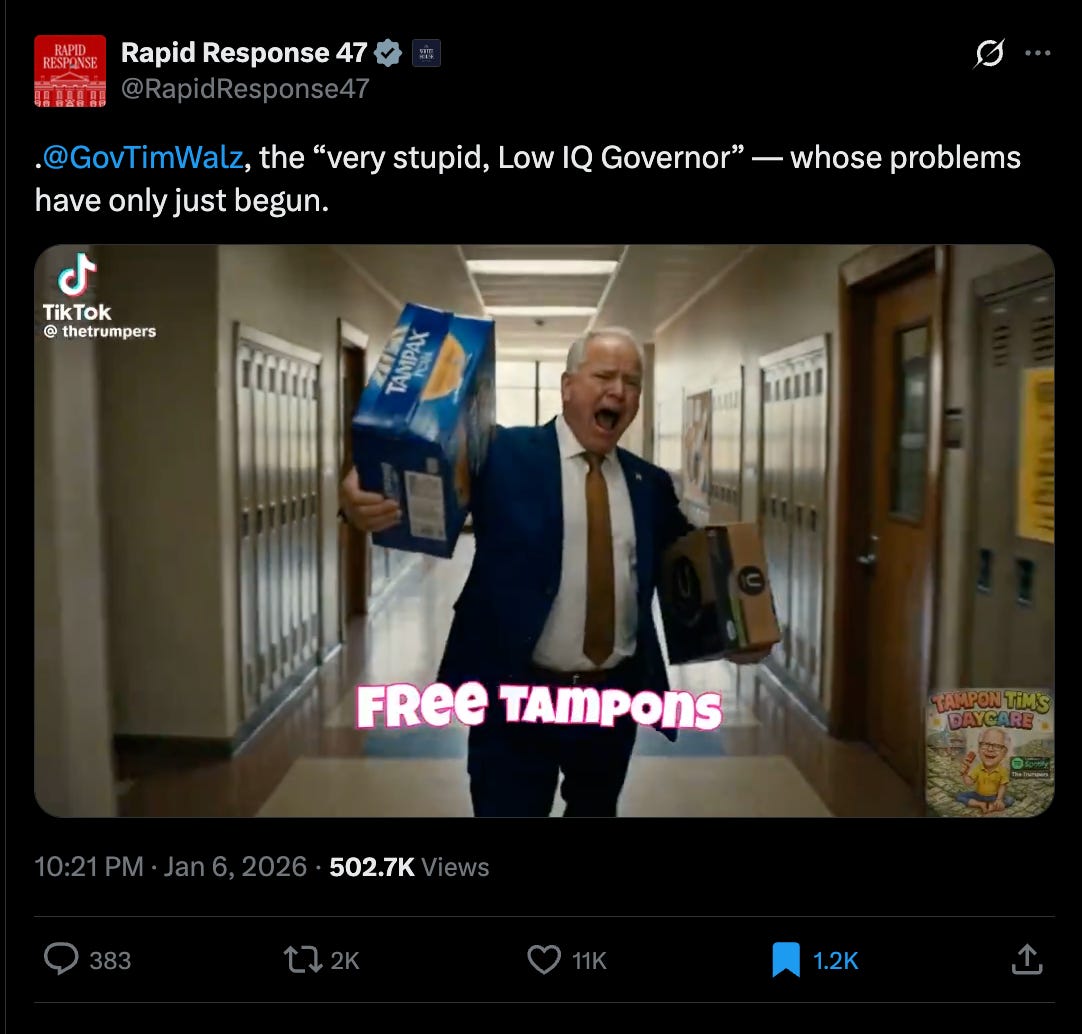
AI Enabled The Trumpers to Capture and Define the Moment at Peak Minnesota Hype
Creating a parody music video to steer the conversation at the moment of peak conversation would have been impossible without AI. Music videos once required songwriters, actors, sets, film cameras, set designers, and more. No longer.
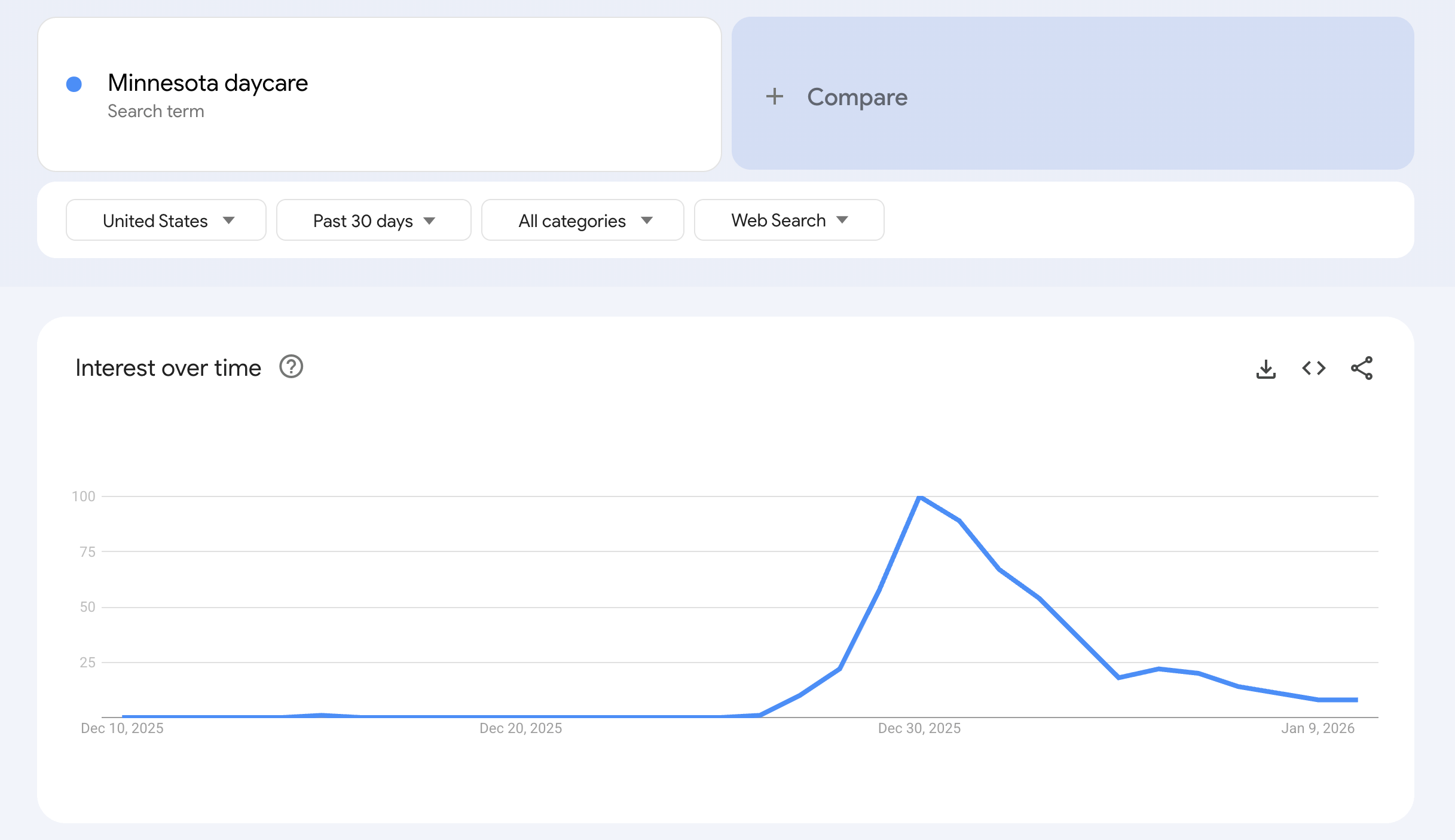
Nick Shirley released a viral YouTube video alleging widespread fraud in Minnesota’s daycare programs on December 26, 2025. The Trumpers posted their music video on December 31st, capturing attention near the peak of Google search volume for ‘Minnesota daycare.’
How Was the Video Made?
The minute-long video consists of a song and 18 separate clips. The creators likely used an app like Higgsfield or Yapper, which provides easy access to video and image models. Let’s break down how it was made.
Music: They most likely used Suno, the highest-quality music generation model.
The workflow is simple: type in the lyrics, specify the style, and press generate. It takes less than 30 seconds and the user can generate multiple songs until the hook works. The cost is marginal.
Estimated cost for the music: $.20
Still frames: When you make an AI video, you rarely start with video. You start with still frames. I assume that they used Seedream Pro, a high-quality Chinese model with limited guardrails. That costs about $0.03 per image. At 18 images exactly that’s $.54.
Estimated cost for the still frames: $0.54
Videos: Now comes the expensive part: turning those stills into motion. I’m going to take a guess and say they used Kling 2.6, a high quality video model out of China that is inexpensive and largely free of guardrails. They uploaded the still frames to define the starting point and created a prompt to specify motion. With 18 videos at likely 8 seconds per clip, we can make the guess that it cost somewhere around $10-20 with the current cost of Kling.
Estimated cost for the videos: $10-20
Re-runs: Likely, there were misfires: videos, images, and songs that missed the mark. So we can make a ballpark estimate that the whole production cost roughly $20–$30.
The Plummeting Cost of Capturing Attention
Based on the model-by-model cost estimates—music, images, video generation, and re-runs—the entire production likely cost at most $30.
A $30 AI-generated meme produced roughly 670,000 organic views across these two accounts—the equivalent of $5,000–$10,000 in paid political distribution—at a CPM (cost per thousand impressions) under five cents.
This is not a story about Tim Walz. It’s not even a story about a crude parody video you may wish you never watched.
It’s a story about what happens when the time and cost to scale influence collapses.
For decades, shaping political attention required heavy campaigns, paid spend, and distribution. You had to buy ads, book talent, rent studios, and negotiate media. Power flowed to whoever controlled those bottlenecks.
AI breaks those bottlenecks. A handful of anonymous creators, armed with generative AI and a few hours, produced a piece of media that was compelling enough to be picked up by the White House because it was already winning inside the feed.
AI is rapidly changing the power laws of the digital public square. The feed is where reality is written.
Play here, or be written out of the story.
Originally published on The Influence Model