 Shaper Collective
The Quiet Arrival of the General Agent
2025's Biggest Breakthroughs and the Future of the Digital Public Square

Over the holidays, in between scrolling year-end roundups and spending time with family, I discovered the quiet arrival of the generally intelligent agent.
Most people in Washington missed it.
With Anthropic’s newest model inside Claude Code, nearly anything that can be done on a computer can now be orchestrated, delegated, and executed by an AI. The implications for opinion shaping are profound. More importantly, it offers an early look at the broader shocks coming to the workplace.
But first, some context on how we got here.
2025 Saw Raw Model Intelligence Increase Across the Board
It’s hard to believe that 2025 was the breakout year for image models. In March, OpenAI released GPT-image and the Studio Ghibli trend introduced millions to AI image generation. The image-to-image function was the most important new feature, allowing users to transform images of themselves or others. This capability, refined by Google’s Nano Banana, is now the bedrock of generative AI memes in politics. You probably had the misfortune of seeing ‘Memeduro in a Bikini’ over the last few days.
Nearly a year into widely available hyper-realistic image models, it’s surprising that the biggest impact hasn’t been the destruction of truth, but a Cambrian explosion of memes.
2025 saw the release of the incredible all-around video models Veo 3 and TikTok-ready Sora 2. Open source Chinese models put extreme price pressure on American labs.
Anthropic and OpenAI released language models in late 2025 that maxed out benchmarks and increased competence in critical tasks like research, writing, and overall reasoning. The METR benchmark for AI R&D tasks showed models completing tasks that would take humans 4 hours with 50% reliability—up from 2 minutes in 2023.
This is all remarkable progress. But many in Washington and beyond don’t feel it.
The Present Drudgery of Working with AI
If you sit behind my desk and watch, you are seeing the future of work. Or, at least, the future as it exists today. Multiple chatbots open, copying and pasting, wrangling different alien minds and crafting optimal conditions for right answers to emerge.
Since my first conversation with a silicon oracle in November of 2022, I’ve watched hallucination rates plummet and capability rise to unthinkable heights. Surely, if you handed me in 2022 a model we have today, I would have said that we achieved AGI.
Yet, using AI has remained a lot of work. The reason: companies have made us the interface between AI and our context—the documents, tools, and skills that only we have.
Let me explain. You set out to ask Gemini to help you understand how a piece of legislation affects your client.
The task starts with a seldom-acknowledged metacognitive exercise—what might Gemini need to read and know, to know what I know, so that it can make a good judgment like me?
You go to your client’s folder and open a Word document—2025 Legislative Priorities. You drag the document into the web version of Gemini. Then, you dig through to the annual planning meeting (January 2025) and copy and paste your notes from OneNote into the question box. Then, you point the AI to the new bill on LegiStorm by giving it a link.
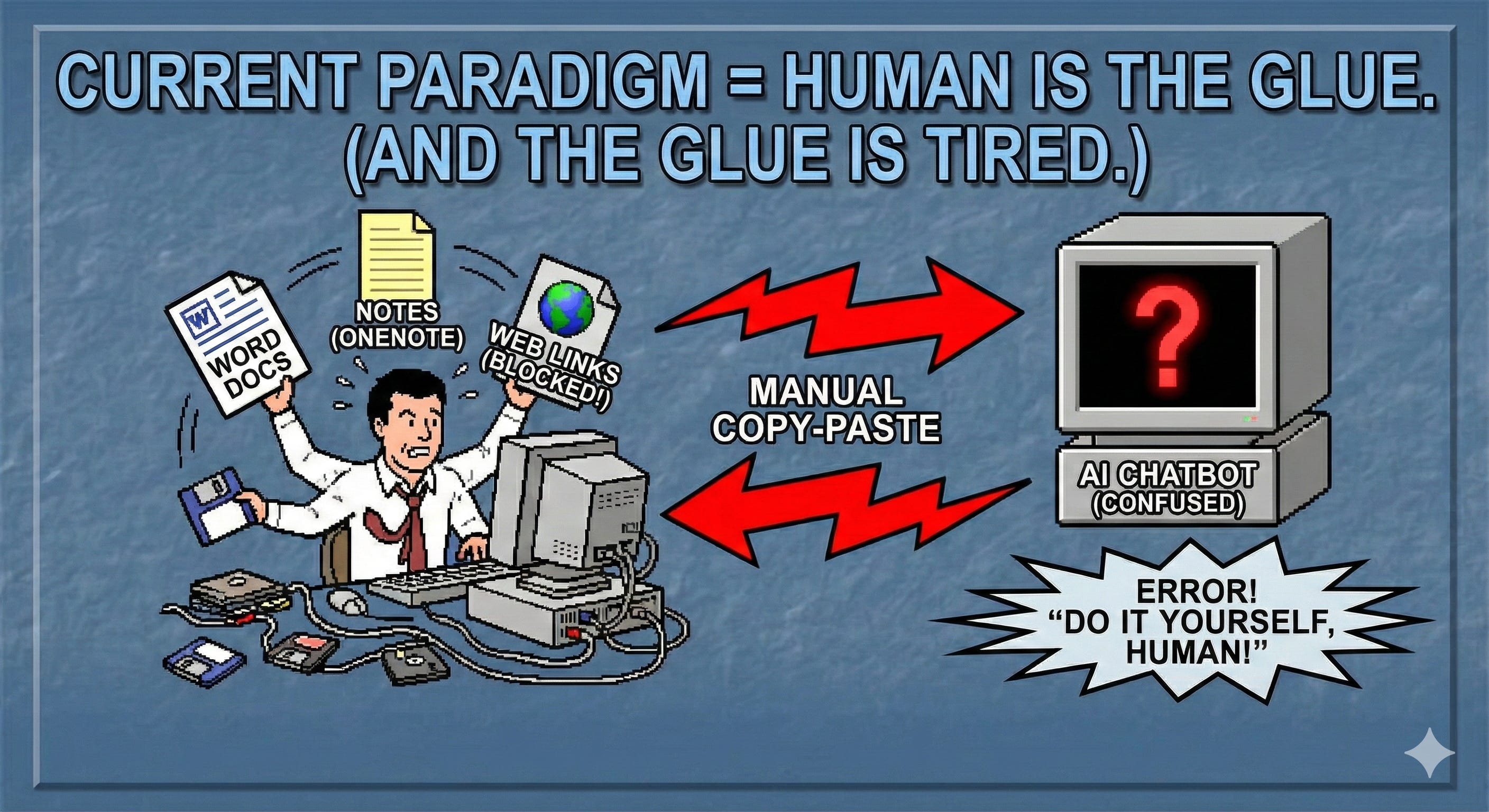
After all of this, you put in the prompt: “Based on the following documents, please analyze how this affects my client.”
All loaded up, you click send, hoping that your mixture of added context and pre-trained knowledge will allow Gemini to make a good judgment. A minute later, Gemini comes back and says it couldn’t access LegiStorm because it’s blocked by a robots.txt, a file that prevents AI crawlers. It asks you to visit the site yourself and copy and paste the relevant information.
Sigh. Is this the future of work?
The General Agent Arrives
Over the holidays, with free time and fewer emails, I, like many others, discovered the arrival of the generally intelligent agent. Its name is Claude Code.
Claude Code is an agent accessed through the command line—the same terminal developers use to run code. But don’t let the interface fool you. It’s not “code” in the sense of programming. Code is how it moves. You click buttons; Claude uses bash.
Claude happens to be good at coding because it was built for it. But anything that is good at coding is, in fact, good at using a computer. It is quite clear that by mid-2026, the system that powers Claude Code (itself open-sourced as the Claude Agent SDK) will be a new product from Anthropic positioned as an agent.
Why?
Claude Code has access to your entire filesystem and can get access to your apps via foundational protocols that Anthropic developed: MCP allows it to talk to apps, Computer Use lets it control your browser, and Skills.md enables repeated tasks.
In the previous example, we’d fire up Claude Code and share the task and client name. It would learn about your client by finding the relevant files in your filesystem. When it hits the robots.txt snag during internet search, it would fire up its own instance of Chrome and open the website, taking a screenshot instead. Then, it would write a file with its analysis.
Just a few things I’ve had Claude Code do:
Run a GEO audit of my website (it searched best practices and sent multiple agents to use my Chrome to implement changes within WordPress by clicking buttons)
Create a CRM and automated prospect enrichment research system
Run end-to-end content creation via agent
Even Boris Cherny, the creator of Claude Code, says that all of his contributions to Claude Code toward the end of the year were 100% created (and tested!) with Claude Code. Sci-fi.
Many organizations invested in complex AI solutions that failed to deliver. Perhaps it’s because startups made the bet that easier user interfaces and more integrations alone would win. I used to think that. But increasingly, AI experts like Ethan Mollick are not as sure. Mollick notes that Microsoft’s bet on app-specific AI is losing to agents like Claude Code that work across apps to complete tasks.
The Bitter Lesson
The bitter lesson is that better AI emerges when general systems are given more computational power. This is bitter because we often (rather stubbornly) believe that we can break bottlenecks by building specialized applications.
Claude Code has existed for a year, but only exploded in popularity as a new model—Opus 4.5—made it a true, dependable helper. Video models gained realistic physics not because they were given a physics class during pre-training. Only a year ago, video models generating gymnastic films was a horror show. Physics emerged from scaling up training data, improving pre-training techniques and increasing compute.
What does the bitter lesson say about using AI in organizations? Keep it simple: make files as light (token-efficient) as possible (in Markdown or YAML), make them accessible (permissions set to yes), and create skills.md files as custom instructions.
Software Engineering is a harbinger for all knowledge work. The gap between the write-by-hand coder or the “copy-paste” ChatGPT coder, and the agent-wrangler is growing.
As significant compute thunders online in 2026, we will see training runs of scale never seen before that will create the next generation of image, video, and language models.
Code generalizes to anything that can be done on a computer.
Don’t Look to the Past to Understand the Future
Too often, we think of the future utility of a technology like AI by using an outdated frame: as a single human operator to a single AI, typing questions and waiting for answers. So we say in the future… “I can create a more realistic video,” or “I can create a better press release,” or “I can research faster and more accurately.”
This is driving in the rear view mirror. The most important impact of the agent is the abstraction of the 1:1 relationship between the user and the AI. Queries will be orchestrated together by super-intelligent managerial “sprites” that ‘live’ on our computer who decompose, plan, delegate, and present results to us.
A single conversation can deploy an entire company of agents.
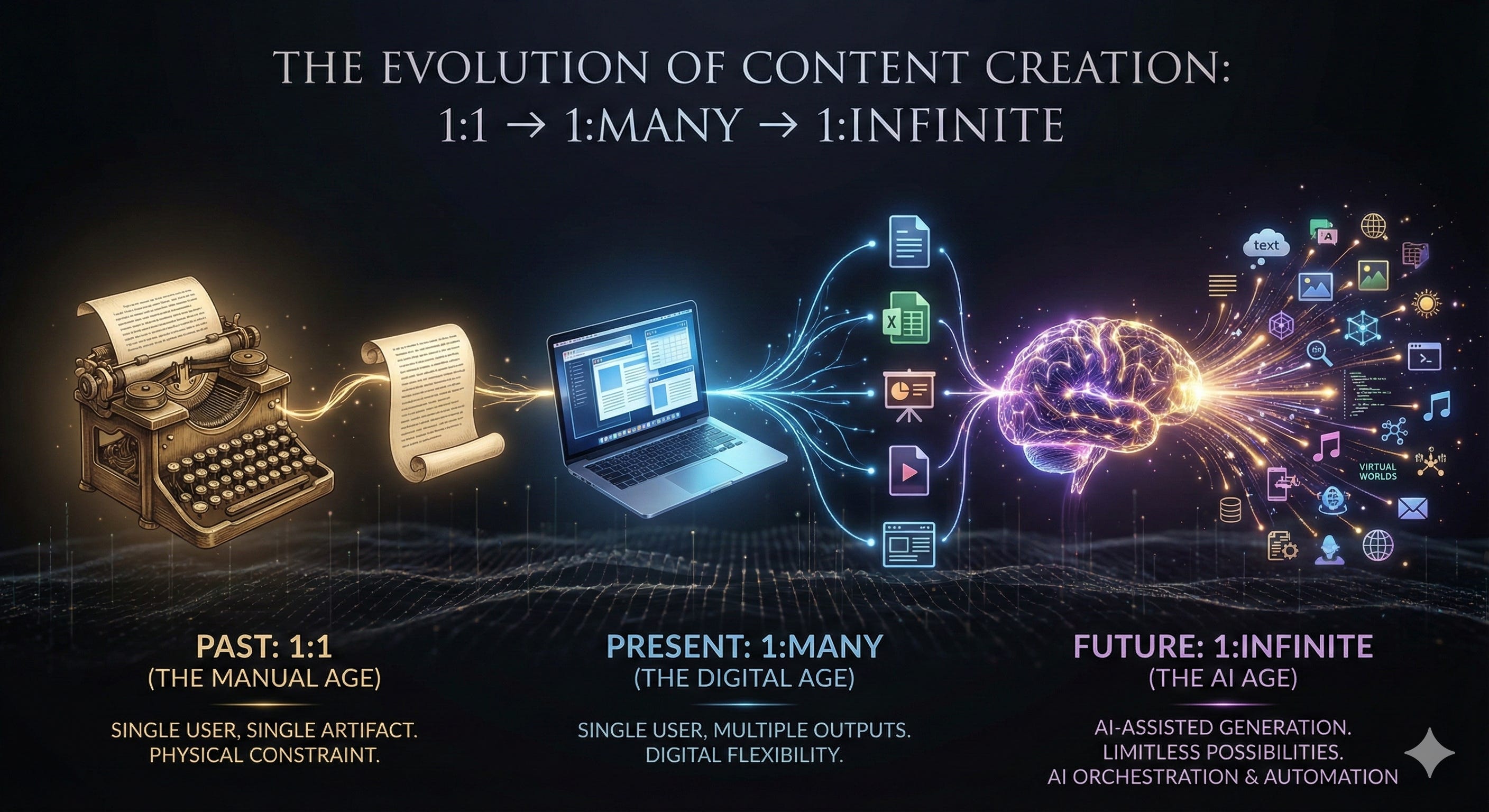
This future has already arrived in limited pockets, where programmers are pushing autonomy to crazed new heights.
See the wild Gas Town repo from Steve Yegge, where a swarm of 100 agents works on a single project at once (the author warns: continue at your own peril and at risk of your entire wallet). Or Ralph Wiggum—yes, really that’s the name of the repo—which lets Claude talk to itself in a recursive loop so it can work while you sleep, assessing its work and prompting “itself.”
What Will Happen in 2026?
Traditional planning assumes a stationary target. In 2026, the target is accelerating toward us. AI capability arrives faster than planning cycles complete. More importantly, execution takes less time than planning in many domains.
What does this mean for the future of our digital public square? Take it from the head of the snake.
Adam Mosseri, Head of Instagram, wrote recently about what he calls “authenticity after abundance.” His core observation is that everything that made creators matter—the ability to be real, to connect, to have a voice that couldn’t be created by machines—is now accessible to anyone with the right tools.
The feeds are filling with compelling synthetic content and labeling won’t work. Platforms will try to fingerprint AI content, but as Mosseri notes, they’ll get worse at it over time as AI gets better at imitating reality.
All of this continues the trend of power shifting from institutions to individuals. Trust in organizations—government, media, corporations—has been declining for decades. In a world of infinite content generated by AI, it appears that we are in the middle of an attentional arms race not only between AI and human-created content but between message and messenger.
Mosseri claims that the messenger will win the attention war. I am far less certain.
The agents have arrived, and they will be able to both create content and join the communities they enter. They will comment, reply, and build context over time. They will follow what I call the “listen like” principle: show up, participate in what matters to the audience, earn trust through presence before they ever mention your issue.
Within an interest-based feed, the message and the relationship become the unit of persuasion, not the identity.
Mosseri is betting that as authenticity becomes a scarce resource, audiences will actively seek out human voices as a countercultural response to AI-generated content. I think he’s overestimating how much people care about provenance when the content is good. Engagement wins. It always has.
The Models Just Work Now
What changed in 2025 is that the capability caught up to the vision across all models. Claude Opus 4.5, GPT 5.2 in particular crossed a quiet threshold where most tasks simply got done well, the first time. Treat an AI like a colleague—explain clearly, brainstorm, plan together—and it performs like one.
The formula for 2026 is deceptively simple: vision, a smart sprite, a bigger wallet, and access to your context. The rest is execution.
Further Reading
If you’ve made it this far, I recommend:
Philip Trammell & Dwarkesh Patel, “Capital in the 22nd Century” — On AI and long-term economics
Zhengdong Wang, “2025 Letter” — A thoughtful year-in-review reflection
Notion, “Steam, Steel, and Infinite Minds” — On AI transformation of the economy
Dan Shipper on the agent paradigm — On the state of agents
Boris Cherny on how he uses Claude Code — The creator’s setup (6M views)
Steve Yegge’s Gas Town — A 100-agent orchestrator
Ralph Wiggum plugin — Let Claude work while you sleep
Originally published on The Influence Model