

The Congressional Inbox Crisis
This week I spoke to Jon Kokot, who’s building Civic after watching Congress drown in constituent communications that AI could actually resolve. He’s tackling workflows specific to the Hill—inbox triage, sentiment tracking, response drafting—but the model works for any organization managing thousands of stakeholder relationships. The efficiency gains are remarkable. The adoption barriers are entirely human.

But first, let’s get into the signals from this week.
The Rundown
The Signals: Seven signals of the future
In the Wild: The White House goes banana
From the Trenches: Interview with Jon Kokot
The Signals This Week
Seven signals of the future of opinion shaping and what they mean for people inside the Beltway.
1. ChatGPT Becomes Primary Information Source as Earned Media Drives AI Responses
New OpenAI research shows information-seeking tops usage; Muckrack tool reveals PR’s new battleground
The number one reason people use ChatGPT according to a new OpenAI study released last week: getting information. Consumers now learn about brands, organizations, and causes through language models, not search engines.
Muckrack’s new Generative Pulse tool analyzed what shapes AI responses. Earned media has enormous sway. Recency matters significantly. Coverage in major outlets and industry publications directly influences what AI says about you.
The fundamentals are familiar from SEO days—increase your digital footprint in reliable sources. But AI isn’t a search result someone scrolls past. It’s a definitive answer delivered with authority.
Something to think about: Traditional media relations becomes more valuable in the age of AI because every earned hit permanently shapes what millions learn about your brand through AI. Build earned media strategies specifically designed to influence model responses. But the road to figuring out how to shape model responses is long—treat anyone saying they’ve figured it out with a healthy dose of skepticism.
2. Golin Deploys AI to Kill Influencer Marketing Guesswork
Platform vets creators 100% faster, delivers insights at 1/10th cost, predicts performance pre-launch
Golin unveiled an AI platform that transforms three influencer marketing bottlenecks. FitCheck analyzes previous posts to determine brand safety and partnership fit in half the time. Influencer IQ delivers near-instant reporting on awareness metrics. Emotiv Intelligence predicts content performance by analyzing second-by-second emotional responses before publication.
The breakthrough I see is ending the guesswork. PR has long operated on instinct. Any system that makes outcomes repeatable collapses approval cycles and increases quality outcomes that clients value.
Something to think about: The same evaluation framework that judges influencer fit could assess legislative messaging or coalition partners. If machines reliably predict emotional response in consumer content, they can do it for policy messaging. Test every frame of your video testimony before it goes live. Optimize for the exact emotional arc you need from your audience.
3. Emotion in a Bottle: AI Models Mental States from 70,000 Psychedelic Experiences
Mind State Design Labs uses AI to isolate specific mental states without the trip
Opinion shaping is mental state engineering. When we craft messaging to move people toward action, we’re trying to trigger empathy, urgency, hope, outrage—specific emotional states that drive behavior. A startup called Mind State Design Labs just figured out how to engineer those states directly, without messaging at all.
The company built an AI system that analyzed 70,000 psychedelic experiences, mapping self-reported feelings to biochemical compounds. The result: what they call “CRISPR for mental states.” Their first product produces what users describe as “seeing new beauty in the everyday world” with none of the hallucinogenic effects. In plain language, it’s emotion in a bottle.
Today, only three mental states come by prescription: focus (Adderall), bliss (Vicodin), contentment (Xanax). Mind State’s breakthrough unlocks many more.
Language models connected dots in data that no human team could handle—thousands of trip reports, chemical structures, neurological effects, finding patterns between molecules and feelings.
Something to think about: Does psychedelics feel like a little bit of a stretch for this newsletter? The same AI pattern-matching that connects molecules to emotions could map which message combinations reliably trigger action in audiences. If the technology can engineer feelings directly, it can certainly predict them. The question becomes: what advantage do you have when everyone can trigger the exact mental state they want in their audience?
4. Katie Parrott Trains AI to Write Like Katie Parrott
Every columnist feeds her essays to ChatGPT until it learns her voice
Everyone who writes with AI knows the robot voice and the cursed em-dashes (which we covered in this week’s podcast). But where there’s a will, there’s a way, and is on the forefront of using AI to write well.
Katie developed a ritual: every time she publishes, she uploads the final draft to a dedicated ChatGPT project. Her prompt: “What do you notice?” The model builds what she calls “the theory of Katie,” identifying features that characterize her writing.
The payoff is edits that sound authentically her. No robot voice. No generic suggestions. Just feedback in her own style, almost like she’s talking to herself.
Read more about how to get AI to write like you, here.
Something to think about: Every client or principal has a distinct voice. Train a model on their past speeches and statements. Now you have an always-available editor that suggests changes they’d actually make, catches phrases they’d never use, maintains consistency across a team of writers. Principals spend less time fixing drafts because AI pre-filtered for their voice.
5. New York Times Digests 500 Hours of Leaked Audio with AI, Won’t Let It Write
America’s paper of record uses AI for research, treats output with journalist skepticism
The New York Times used AI to transcribe 500 hours of leaked Zoom recordings from an election interference group—five million words—then identified the newsworthy segments. The resulting investigation would have been impossible with traditional methods.
, who leads the newsroom’s AI strategy, has trained nearly the entire staff. His approach: AI for research and bounded tasks, never for article writing. AI can draft SEO headlines, but not journalism. His instruction to reporters uses language they understand: “Treat AI output with the suspicion you’d give a source you just met.”
Something to think about: When your core product is writing, you protect writing but deploy AI everywhere else. Congressional offices produce statements, speeches, legislative language as their core output. The Times model applies directly: use AI to process constituent feedback, digest hearing transcripts, research policy precedent. Be sensitive letting it write the final product.
6. Moldova Election Shows AI-Driven Influence Operations Reach Industrial Scale
Romanian think tank tracks 13.9 million TikTok views from 100 fake accounts attributed to Russia
Ahead of Moldova’s parliamentary election, monitoring groups documented an AI-enabled Russian misinformation campaign fundamentally different from previous operations. Spoof websites impersonate Western media. Engagement farms in Africa drive traffic. Bots flood comment sections.
The most effective vector: 100 inauthentic TikTok accounts generating 13.9 million views. Expert Forum, a Romanian think tank, noted the change: “AI can generate complete profiles, realistic photos, credible biographies, and varied content in minutes that would have required weeks of manual work.”
What previously required teams now runs on automation.
Something to think about: The automation that enables covert campaigns is available to everyone. While platforms chase bot detection, there’s an opening for legitimate advocacy to scale message testing and rapid response without traditional overhead. The strategic question: how do you build campaign infrastructure that achieves Moldova-level speed but serves actual constituents?
7. Congress Has No Deepfake Response Plan with 2026 Midterms Approaching
Politico reports bipartisan alarm as AI video quality surges and legislators remain unprepared
Representatives Sarah McBride and Jay Obernolte, Democrat and Republican respectively, both told NOTUS that Congress lacks deepfake response plans despite expecting significant misinformation in the upcoming midterm season.
The quality of AI-generated video, photos, and voice has exploded in recent months. Trump and parts of the GOP have embraced deepfakes as meme culture—it hasn’t hurt them. It’s unclear if other legislators have that immunity. The consequences could be serious.
Bipartisan concern, but still no coordinated response.
Something to think about: Trump’s immunity to deepfakes comes from his brand already living in hyperbole and meme space. For other public figures, authenticity is the asset that gets destroyed. The defensive play: establish verification systems now. Regular video statements from verified accounts, communication protocols that confirm identity, rapid response teams trained on deepfakes. The offensive play: use the same tools to flood the zone with your own narrative before opponents can deploy fakes.
In the Wild
How AI is actually being deployed in political campaigns and influence operations right now.
White House goes banana (Uses Nano-Banana for TikTok Announcement)
The Trump White House used Google’s Nano-Banana to create the image to announce the TikTok deal. The telltale sign is the watermark in the bottom right corner—can you see it? Professional-quality visual content generated in minutes using a consumer AI tool, deployed immediately to millions and they didn’t bother to remove the watermark (because, frankly, nobody cares). What’s your excuse for slow?

From the Trenches
Each week, I sit down with practitioners who are actually using AI to change how influence works.
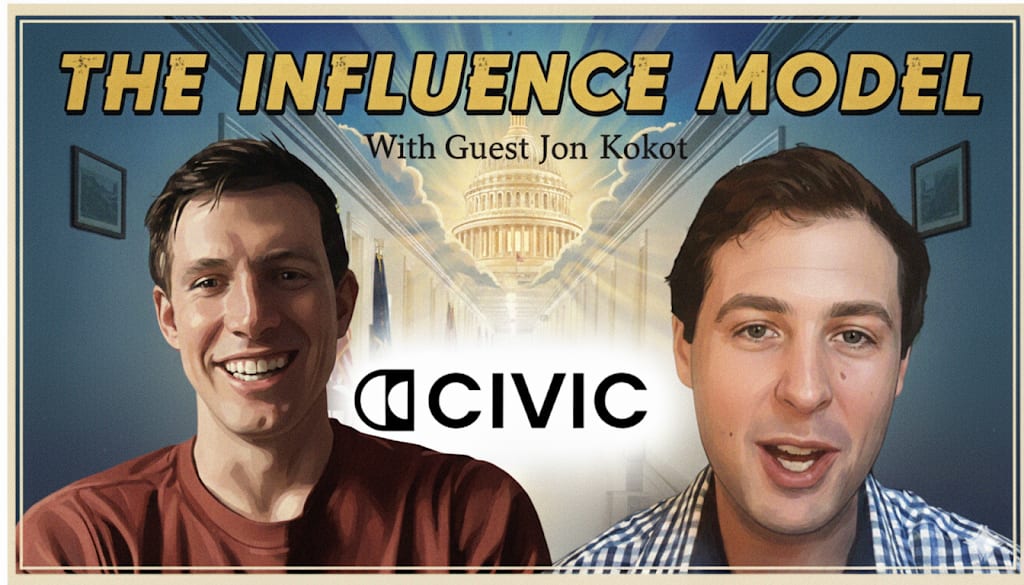
From the Trenches: Jon Kokot on Building AI for Congress
Jon Kokot spent six years flying helicopters for the Navy before becoming a legislative affairs officer on Capitol Hill. Now he’s building Civic, a platform that’s automating the most broken workflow in Congress: constituent communications.
The Inbox Crisis
Congressional offices are drowning. One office has 300,000 emails in their backlog. Another received 31,000 voicemails in a single week during the 2022 speaker changeover. They listened to every single one because buried in that pile could be a constituent threatening the member’s life.
In the AI age, shaping opinions in Congress has become an arms race. Outsiders—corporations, lobbyists, advocacy groups—use platforms like Quorum and FiscalNote to leverage AI and flood congressional inboxes. Congress has no AI on the receiving end to break the bottleneck. Junior staffers, usually 22 or 23, spend 90% of their day trying to read, tag and respond to an impossible stream of messages. It’s not good for anyone.
Solving Constituent Problems Comes Down to Data
When you strip away the technical layers, Civic’s approach is straightforward: build a comprehensive profile of every constituent interaction.
It’s a powerful idea: What if you had an internal model of all the ways a constituent ever talked to you? Every email about immigration, every voicemail about veterans’ benefits, every town hall question. That complete picture becomes your interface with AI.
“You can use ChatGPT to can create a custom GPT, throw 10 documents into a data room and it’ll do a pretty good job,” Jon explained. “But where it falls short is it’s pulling from the entire ocean of data.”
Civic instead syncs a vector database of 300,000 bills since 1975. The system reads messages, extracts data tags, builds constituent profiles, batches similar messages, and generates responses in the member’s voice. No em-dashes.
AI For Better Government
Right now, casework happens when a constituent reaches their breaking point. With Civic’s platform, offices can monitor social media, identify constituents posting about problems publicly, and reach out before they even ask for help.
“We don’t want to stop with Congress,” Jon said. “The ultimate goal is to put Civic on both ends—in Congress and in federal agencies. Close the gap. Solve constituent casework at the speed of the constituent.”
The vision: AI agents supervised by humans, sending documents, interfacing with agencies, requesting signatures. One caseworker could supervise 10x or 50x the volume they handle today. Ultimately, the goal is better government that works for the people.
…You non-Spotify people can now find it live on Youtube.
Thank you for reading this edition of The Influence Model. Reply and let me know what you think and what you’d like to see covered next week.
Have a great weekend,
Ben


Leave a Reply
Want to join the discussion?Feel free to contribute!